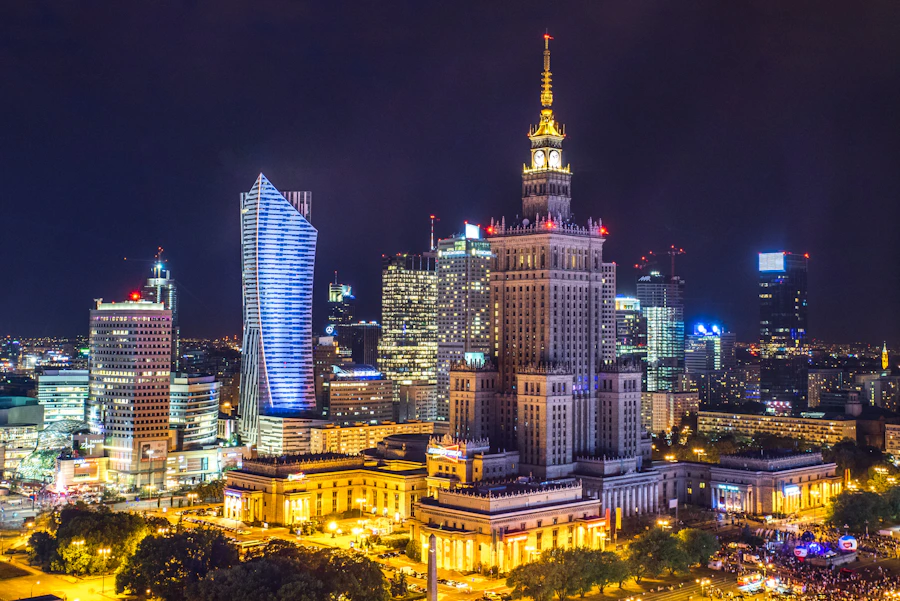
Choosing the best Polish city for Asian workers in 2026 is one of the biggest decisions you will make after deciding to come to Poland. For families from India, Bangladesh, Sri Lanka, Nepal, Pakistan, the Philippines, Vietnam, Nigeria and Zimbabwe, the right city affects your salary, rent, Karta Pobytu (Polish residence permit) waiting time, school options for your children, and whether you will find a community that feels like home. Warsaw, Kraków, Wrocław, Gdańsk, Poznań, Szczecin and Katowice each have very different costs, job markets and immigration office experiences. This guide compares them honestly so you can decide where to start your life in Poland — or where to move next if you are already here. We will look at wages, rent, residence permit timelines, transport, and Asian community presence, and finish with a step-by-step checklist for picking the right city for your situation.
Warsaw — Capital of Opportunity for Foreign Workers
Warsaw is the obvious starting point when comparing the best Polish city for Asian workers. It hosts roughly a quarter of all Karta Pobytu applicants in Poland, the largest Indian, Bangladeshi and Sri Lankan communities, the most international schools, and the highest wages — averaging 9,200–10,500 PLN gross for skilled workers in 2026. The trade-off is the highest rent and the longest residence permit processing time at the Mazowiecki Urząd Wojewódzki, often 8–14 months for first applications.
- Average rent for a 2-room flat in 2026: 3,600–4,800 PLN in central districts, 2,700–3,400 PLN in Ursus, Białołęka or Bemowo — manageable on two incomes.
- Direct flights to Delhi, Dhaka, Colombo, Manila and Lagos via LOT and Qatar Airways from Warsaw Chopin — important for families visiting relatives.
- Indian grocery shops in Praga and Ochota, several active gurdwaras and mosques, halal butchers around Marszałkowska Street.
- Largest IT, finance, BPO and logistics job market in Poland, with English-speaking employers like Citi, Accenture, Samsung and JP Morgan actively hiring Asian talent.
If you are moving with children or want a safer family neighborhood, we cover the best districts in detail in our safe neighborhoods guide for Asian families. For the Karta Pobytu strategy specifically in Mazowieckie, see our Warsaw residence permit strategy guide.

Kraków — Best Polish City for Indian IT Workers
Kraków is the favourite Polish city for Indian IT specialists, software engineers and Blue Card holders. The salaries are slightly lower than Warsaw — around 8,000–9,500 PLN gross for mid-level developers — but rent is 25–30% cheaper and the city is smaller and easier to navigate. The Małopolski Urząd Wojewódzki processes residence permit applications in about 6–10 months for clean cases, which is faster than Warsaw.
- Strong IT employer base: Cisco, Motorola, IBM, Comarch and Capgemini employ thousands of Indian and Filipino engineers in Kraków.
- Rent for a 2-room flat in 2026: 2,800–3,800 PLN in central Kazimierz or Krowodrza, 2,200–2,900 PLN in Bronowice or Nowa Huta.
- Active Indian Cultural Association of Kraków organising Diwali, Holi and Pongal events; multiple Indian restaurants on Józefa and Karmelicka streets.
- Excellent international schools (British International, American International School) and Jagiellonian University for spouses pursuing graduate studies.
For IT specialists comparing Poland against the Gulf, our Poland vs UAE for Indian workers guide explains the long-term financial picture. Kraków salaries are lower than Dubai in cash terms, but Karta Pobytu and EU residence make Poland a stronger 10-year choice for most families.
Wrocław — Affordable City with Growing South Asian Community
Wrocław has become one of the fastest-growing destinations for Asian workers in Poland, especially Bangladeshi, Sri Lankan and Nepali families. The Dolnośląski Urząd Wojewódzki has a reputation for relatively quick decisions — many first Karta Pobytu cases close in 4–8 months. Rent is about 30% lower than Warsaw, the city is bike-friendly, and the logistics, manufacturing and IT sectors all hire actively.
- Rent for a 2-room flat in 2026: 2,400–3,300 PLN in central Krzyki, 1,900–2,600 PLN in Fabryczna or Psie Pole.
- Major Asian-friendly employers: LG Electronics, Bosch, Volvo, Credit Suisse, Nokia and a nearby Amazon fulfilment centre.
- Mosque on Kniaziewicza Street, Hindu temple meetups in rented community halls, halal shops on ul. Brzeska.
- Strong Polish language schools for adult workers — the city government partly subsidises evening Polish courses for foreigners on Karta Pobytu.

Gdańsk, Poznań, Szczecin and Katowice — Strong Alternatives
Outside the big three, four more Polish cities deserve a serious look from Asian workers in 2026. Each has a different specialisation, different residence permit waiting time and different cost profile. The wrong choice is staying in an expensive city when your job and family could thrive elsewhere — Poland gives you full mobility once your Karta Pobytu is issued, but choosing well from day one saves months of relocation hassle.
- Gdańsk: logistics, shipping, IT, and Amazon — rent 2,300–3,200 PLN, residence permit 5–9 months at the Pomorski Urząd Wojewódzki, very strong Filipino seafarer community.
- Poznań: automotive (Volkswagen, Solaris) and warehousing — rent 2,200–3,100 PLN, residence permit 6–10 months, low crime rates, popular with Vietnamese families.
- Szczecin: food processing, shipyards, fast-growing IT — rent 2,000–2,800 PLN, residence permit 4–7 months at the Zachodniopomorski Urząd Wojewódzki.
- Katowice: mining services, automotive, BPO — rent 2,100–2,900 PLN, residence permit 5–9 months, a large Indian and Vietnamese restaurant scene serving the Silesian metro region.
Szczecin in particular has earned a reputation for moving Karta Pobytu cases quickly — see our detailed Szczecin voivode rules guide if your job offer is in the Zachodniopomorskie region.
Practical tip: do not pick a city based only on rent. Calculate (gross salary − rent − utilities − transport to work) for two cities and compare the actual money left in your pocket each month before making the move.
How to Decide Which Polish City Fits Your Family
There is no single best Polish city for every Asian worker — the right answer depends on your job offer, family size, savings and long-term plan. The official immigration portal at gov.pl/web/cudzoziemcy lists residence permit requirements that are the same nationwide, but each voivode applies them at different speeds, and your real take-home depends on local taxes and rent.
- Start with the job offer in writing. Salary is fixed, rent is negotiable. A 9,500 PLN offer in Wrocław often beats a 9,800 PLN offer in Warsaw for most families.
- Check the Karta Pobytu waiting time at your voivode by calling Legal Solutions or reading the latest data on the regional office website before signing the lease.
- Calculate your net pay correctly: gross salary is usually 70–72% net after ZUS social security and PIT tax, and the rate is identical in every city.
- Visit the city for 3–4 days before signing a long lease. Walk the neighbourhood at 9 PM and on Sunday morning — that tells you more than any guide.
- Find your community before moving. Join the local Indian Association, Bangladeshi WhatsApp group, Sri Lankan church or Filipino parish — they will help with the first 30 days.
- Plan your Karta Pobytu submission within 14 days of arrival to avoid stamp or visa overstay risk. A professional agency knows the local voivode's preferences.
Verify the official social-security and health-insurance contribution rates at zus.pl before accepting any offer, and check residence permit news on your regional voivode's site — for example the Mazowiecki Urząd Wojewódzki for Warsaw. These two sources are more reliable than any forum post.

Choosing the right Polish city is the first big step in building your family's future, and the wrong choice costs months of rent, transport and stress. Talk to Legal Solutions — 98% approval rate.